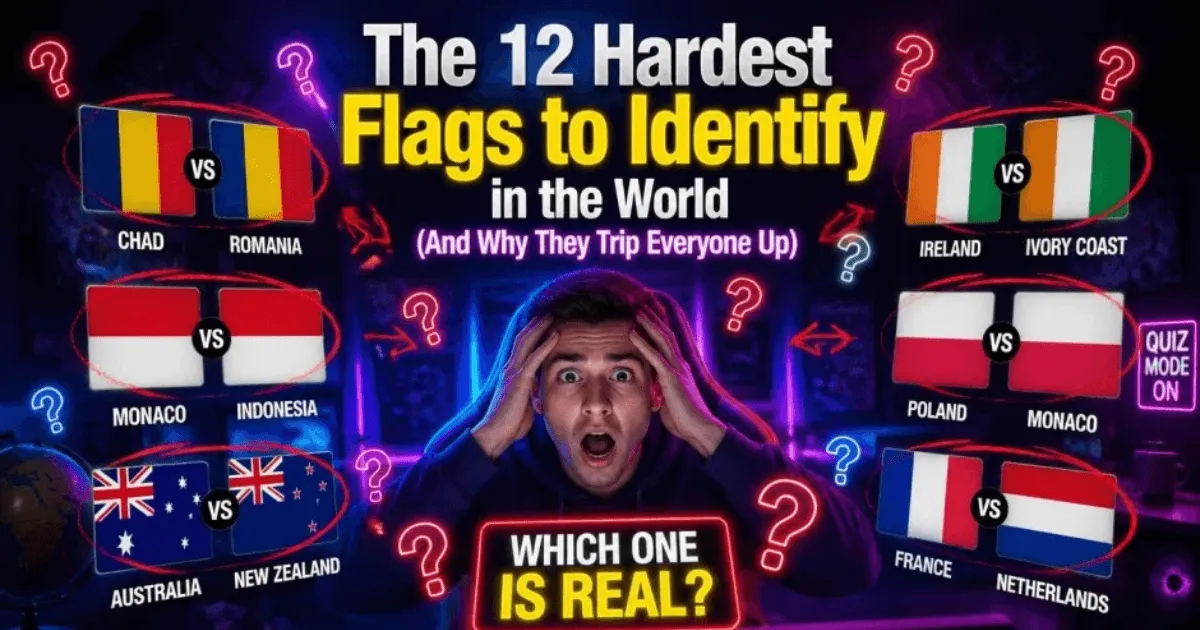
Some flags are genuinely, objectively difficult to identify. Not because of limited geography knowledge, but because certain flags look almost identical to others, feature symbols from cultures that rarely appear in mainstream media, or share colors with a dozen neighboring countries. Even experienced players pause on these.
This guide covers the twelve flags that trip up even seasoned Flagle players. For each one, the exact reason it is hard is explained along with a mental hook to finally lock it in. If you play Flagle Unlimited regularly, these are the ones worth studying first.
Table of Contents
- 1. Turkmenistan — The Most Complex Flag on Earth
- 2. Mozambique — The Only Flag With an AK-47
- 3. Chad and Romania — Nearly Identical Tricolors
- 4. Belize — A Coat of Arms That Demands a Magnifying Glass
- 5. Sri Lanka — The Lion With a Sword
- 6. Bolivia — Red, Yellow, Green or Is It Ethiopia?
- 7. Kazakhstan — The Sun With 32 Rays
- 8. Indonesia and Monaco — Horizontal Red Over White
- 9. Slovenia, Slovakia, and Russia — The White-Blue-Red Confusion
- 10. Haiti — Blue and Red With a Hidden Coat of Arms
- 11. Bhutan — The Dragon That Surprises Everyone
- 12. Kyrgyzstan — The Tunduk at the Center
- Why Hard Flags Are an Advantage in Flagle
1. Turkmenistan — The Most Complex Flag on Earth
Turkmenistan's flag is widely considered the most intricate national flag in existence. On the left side runs a vertical stripe containing five traditional carpet guls, which are ornate geometric patterns representing the country's five major tribes. The rest of the flag is solid green with a white crescent moon and five white stars.
The problem is threefold. The carpet patterns are extraordinarily detailed, tiny, symmetrical, and nearly impossible to sketch from memory. Most players have limited geographic exposure to Central Asia, so there is no automatic mental association. And the green-white crescent combination is shared by several other countries, so even if you notice those elements, the first guess might be Pakistan or Saudi Arabia instead.
How to remember it: Think "Turkish carpet": Turkmenistan, carpets, green. The carpet stripe is on the left, and once you know to look for it, there is no flag like it anywhere in the world.
2. Mozambique — The Only Flag With an AK-47
Mozambique holds a unique distinction: it is the only national flag in the world that features a modern firearm, specifically an AK-47 with a bayonet attached, crossed over a hoe and a book. These sit on a red triangle at the hoist.
The rest of the flag uses horizontal stripes of green, black, and yellow separated by narrow white bands, a common Pan-African color combination shared by many neighboring countries. This is precisely what makes it hard. The eye jumps to the stripes and thinks "Africa, probably one of many," before it even registers the extraordinary symbol on the left.
How to remember it: Once you know the AK-47 is there, you will never forget it. Mozambique fought a brutal civil war and independence struggle. The rifle represents vigilance and defence. No other flag has anything close to this.
3. Chad and Romania — Nearly Identical Tricolors
The flags of Chad and Romania are almost indistinguishable. Both are vertical tricolors of blue, yellow, and red, in exactly that order. The only difference is a tiny variation in the shade of blue, which is completely invisible on most screens and in most lighting conditions.
Officially, Chad's blue is slightly darker. In practice, even national flag authorities have acknowledged this is one of the most confusing pairs in the world. The United Nations has noted the similarity in diplomatic contexts.
How to remember it: Context is everything here. If the distance indicator shows you are in Africa, it is Chad. If you are in Europe, it is Romania. There is no visual trick; geographic clues are the only reliable method.
4. Belize — A Coat of Arms That Demands a Magnifying Glass
Belize's flag is blue and red with a white circle in the center containing a full coat of arms. That coat of arms includes two men holding tools, a sailing ship, a mahogany tree, a shield with detailed imagery, and a Latin motto. At small sizes, it looks like a circular blue smudge with a faint impression of something.
Belize is also not a country that receives significant media coverage internationally, so most players have limited prior exposure to the flag. Combined with the complexity, it is routinely cited as one of the hardest to identify in geography games.
How to remember it: Belize is in Central America and uses the only flag in the world where the coat of arms features two men and a mahogany tree. Blue flag, white circle in the middle, Central America. That combination narrows it down quickly.
5. Sri Lanka — The Lion With a Sword
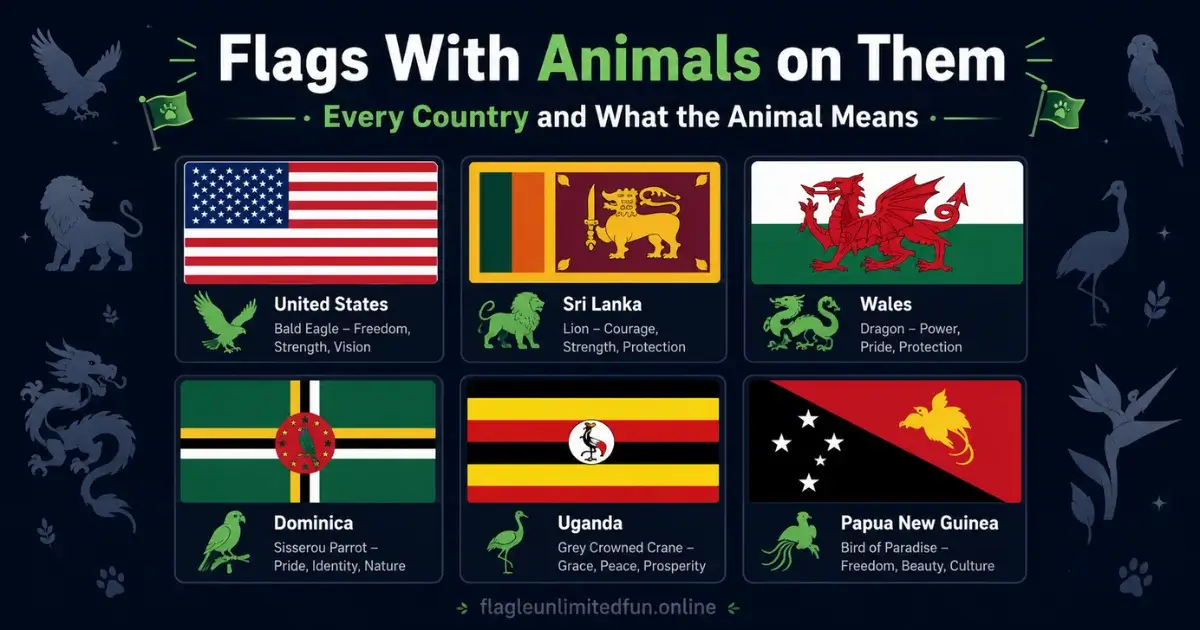
Sri Lanka's flag features a golden lion holding a sword on a dark maroon background, surrounded by golden leaves. In each corner is either an orange or green stripe representing the Tamil and Muslim minorities. Research from Preply that surveyed flag recognition found Sri Lanka had the lowest correct identification rate for both color palette and symbol accuracy, with only 5 out of 23 participants correctly identifying the color palette.
The maroon color is unusual. It is not red, not burgundy, not brown. The lion itself is detailed and stylized. And the combination of orange, green, and maroon is not found on any other major flag, making it hard to place in any mental category.
How to remember it: Think "lion with sword, maroon background, South Asia." The sword is the key detail. Not many flags have a sword, and Sri Lanka's lion holds one specifically. Once that image is fixed, it will not be confused with anything else.
6. Bolivia — Red, Yellow, Green or Is It Ethiopia?
Bolivia's flag is a horizontal tricolor of red, yellow, and green. Ethiopia's flag is a horizontal tricolor of green, yellow, and red. Both have the same three colors, just in different orders. Bolivia's goes red-yellow-green top to bottom. Ethiopia's goes green-yellow-red. In a fast-paced flag game, many players reverse them.
Making this worse, the Pan-African movement adopted Ethiopia's colors as a symbol of African independence, meaning many African countries including Ghana, Cameroon, Guinea, and Senegal also use green, yellow, and red. Bolivia stands alone as the South American country using this combination, which is precisely why it feels out of place and hard to remember.
How to remember it: Bolivia has red on top. Ethiopia has green on top. If the distance indicator shows you are in South America and you see these three colors, it is Bolivia.
7. Kazakhstan — The Sun With 32 Rays
Kazakhstan's flag is sky blue with a golden sun on the right and a soaring steppe eagle below it. On the left runs a vertical band of traditional ornamental patterns. The blue is bright and distinctive, the eagle is beautifully detailed, and the sun has exactly 32 rays representing prosperity and happiness.
The difficulty is not the flag itself but rather that Central Asia as a region is underrepresented in popular geographic knowledge. Most players encounter Kazakhstan rarely and have not built a mental image of its flag. Additionally, the ornamental pattern strip on the left can be confused with Turkmenistan at a glance, despite looking quite different up close. Our Asian flags guide covers Central Asia in detail.
How to remember it: Sky blue, eagle, sun, decorative left strip. Kazakhstan is the largest landlocked country in the world. The blue reflects the vast steppe sky. Associate the color with the geography and the eagle becomes obvious.
8. Indonesia and Monaco — Horizontal Red Over White
Both Indonesia and Monaco have flags that are simple horizontal bicolors: red on top, white on the bottom. The only technical difference is the aspect ratio. Monaco's flag is slightly more square. In a digital flag game, this difference is almost impossible to spot reliably.
The saving grace in Flagle Unlimited is the distance indicator. If the previous guess placed you somewhere in Southeast Asia, it is Indonesia. If it placed you in Western Europe, it is Monaco. There is genuinely no reliable way to distinguish these flags visually; geographic context is essential.
How to remember it: Use the game's geographic tools. Indonesia is enormous, with more than 17,000 islands. Monaco is one of the smallest countries in the world. They could not be more different, yet their flags are twins. Read our distance indicator guide to use this tool effectively.
9. Slovenia, Slovakia, and Russia — The White-Blue-Red Confusion
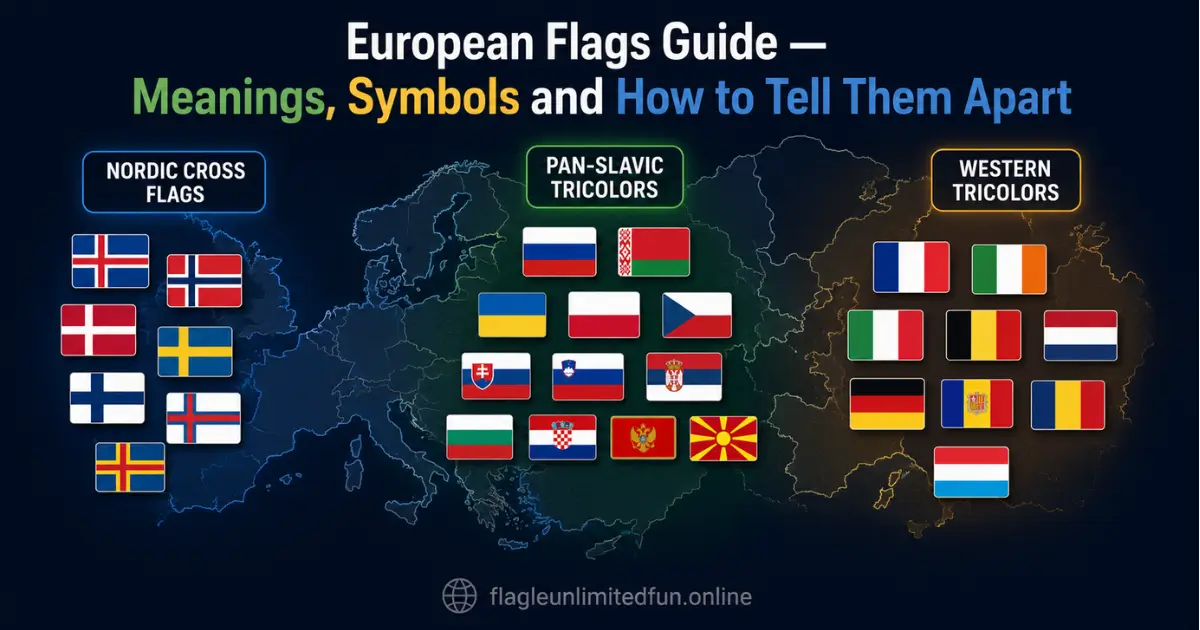
All three of these flags are horizontal tricolors of white, blue, and red. Slovenia and Slovakia both have coats of arms on the left side to distinguish themselves, but at small sizes these are hard to read. Russia has no coat of arms, just the three clean stripes.
Slovenia's coat of arms features Mount Triglav with three stars above it. Slovakia's features a white double cross on a blue and red shield. When the coat of arms is not clearly visible, all three flags look essentially the same.
How to remember it: Russia has no emblem. Slovenia and Slovakia both do. For those two, the mountain versus the cross is the key distinction. Slovenia sits further west, near Italy and Croatia. Slovakia is landlocked in Central Europe. Use the distance indicator to separate them geographically.
10. Haiti — Blue and Red With a Hidden Coat of Arms
Haiti's flag uses horizontal blue and red stripes with a white rectangle in the center containing an elaborate coat of arms. The coat of arms includes a palm tree, cannons, cannonballs, flags, a trophy, and a green hill, all rendered in fine detail on a tiny white square.
The blue-red combination alone is not unique. The coat of arms is what sets Haiti apart, but it is so detailed that at standard flag sizes it appears as a vague white rectangle with something in it. Haiti is also geographically isolated, on the island of Hispaniola in the Caribbean, so knowing the region helps but identifying Haiti specifically still requires knowing what to look for.
How to remember it: Haiti, blue over red, elaborate central emblem. The first Black republic in the world, its flag tells a story of revolution. The palm tree at the center is surrounded by weapons because independence was won through struggle.
11. Bhutan — The Dragon That Surprises Everyone
Bhutan's flag is diagonally divided into orange and yellow, with a white dragon called the Druk, or Thunder Dragon, across the center. It is completely unlike any other flag in the world, yet players consistently fail to identify it in flag games.
The reason is simple. Bhutan is a small, landlocked Himalayan kingdom with limited global media presence. Most people have never consciously thought about what Bhutan's flag looks like before encountering it in a game. The dragon itself is beautifully rendered but unexpected, and the brain has no prior association to activate.
How to remember it: Once you see the Bhutan dragon flag, you will never forget it. There is no other national flag with a dragon. Orange-yellow diagonal, white dragon. Bhutan is the Land of the Thunder Dragon. That is the entire mental hook.
12. Kyrgyzstan — The Tunduk at the Center
Kyrgyzstan's flag is red with a yellow circle at the center. Inside the circle is a stylized representation of the top of a traditional nomadic tent called a tunduk. It looks like a wheel with curved spokes, or a slightly abstract snowflake. The 40 rays of the sun represent the 40 tribes united by the legendary hero Manas.
The difficulty is the symbol itself. Most players see a red flag with a circular yellow design and think "sun," which is technically correct but does not help identify the country. The specific pattern inside the circle is unique to Kyrgyzstan, but recognizing it requires knowing what a tunduk looks like.
How to remember it: Red flag, yellow circular pattern that looks like the inside of a tent. Central Asia, nomadic culture, 40 tribes. If you see a red flag in Central Asia with an unusual circular geometric symbol, it is Kyrgyzstan. Use strategic first guesses to confirm the region before committing.
Why Hard Flags Are Actually an Advantage in Flagle
The flags that are hardest to identify are also the most valuable ones to learn. In Flagle Unlimited, every player knows Japan, France, and Brazil. The players who separate themselves from the crowd are the ones who can confidently identify Turkmenistan, Kyrgyzstan, and Mozambique, because those become automatic points while everyone else is guessing.
Study the hardest flags first. Build mental anchors around their unique features. Use Flagle's distance indicator to eliminate geographic possibilities before committing to a guess. The flags that seem impossible today will feel obvious after twenty encounters.
The best flag players are not people with photographic memories. They are people who understand why flags look the way they do, including the history, geography, and culture behind each symbol. That context is what makes identification reliable rather than lucky. Start with the Daily Challenge every day and track how quickly these twelve flags start to feel familiar.