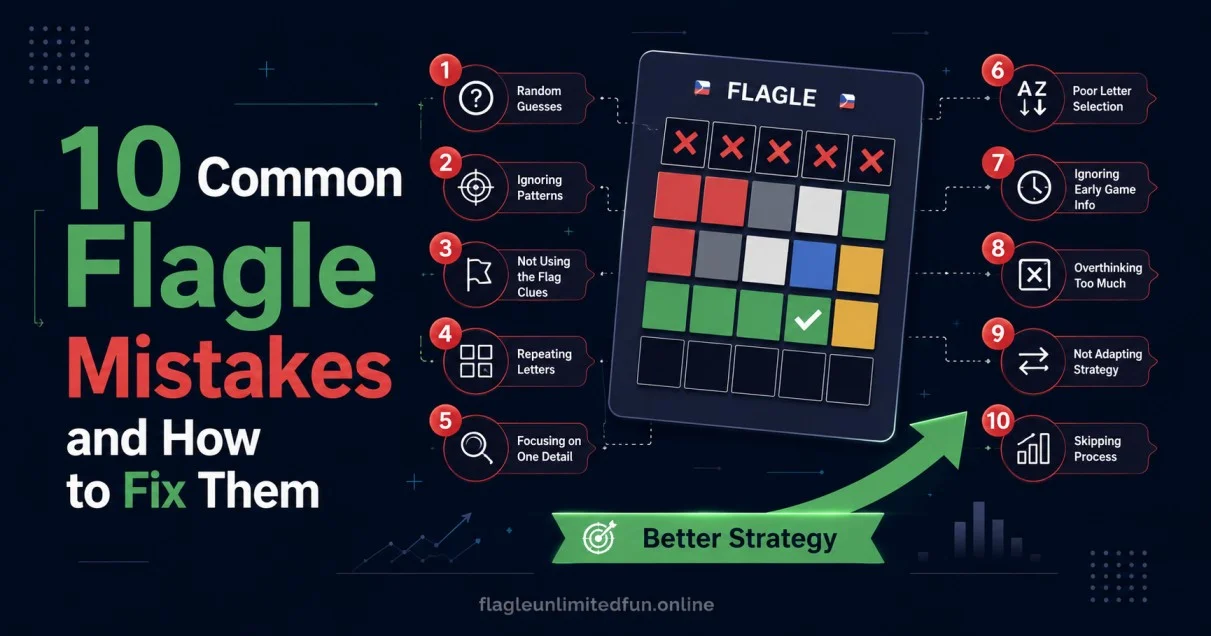
Most Flagle players hit the same walls at the same points in their development. They start strong, win a few games easily on flags they recognize, and then encounter a run of unfamiliar flags that exposes gaps in their approach. The problems are almost always the same, and so are the fixes.
This guide covers the most common mistakes Flagle players make, explains exactly why each one costs attempts, and gives you a concrete alternative to use instead. If you have been stuck at an average of four or five attempts and cannot seem to get it lower, at least one of these is probably why.
The Core Problem
Most Flagle mistakes come from treating the game as a flag recognition test when it is actually a geography deduction game that uses flags as its medium. Players who shift from "what flag is this?" to "where in the world is this?" consistently outperform those who do not, even when their flag knowledge is identical. The mistakes below are almost all symptoms of the same underlying error.
Table of Contents
- Mistake 1 — Guessing Randomly When You Do Not Recognize the Flag
- Mistake 2 — Ignoring the Direction Arrow
- Mistake 3 — Starting With Small or Remote Countries
- Mistake 4 — Guessing to Confirm Instead of to Eliminate
- Mistake 5 — Getting Stuck on Visually Similar Flags
- Mistake 6 — Skipping the Daily Challenge
- Mistake 7 — Not Reviewing Losses
- Mistake 8 — Relying Only on Color for Identification
- Mistake 9 — Having No Mental Map of the World
- Mistake 10 — Rushing the First Guess
Mistake 1 — Guessing Randomly When You Do Not Recognize the Flag
When a flag appears and you have no idea what it is, the worst thing you can do is start guessing countries that feel vaguely plausible. Random guessing burns attempts without generating useful information. Even if you happen to be correct, you learned nothing that will help you next time.
The fix is to treat every guess as a geographic probe, regardless of whether you recognize the flag. If you have no visual information to work with, choose a country that is geographically positioned to give you maximum information. Russia, Brazil, Nigeria, and India are large, centrally positioned countries that generate useful distance and direction data no matter where the correct answer is. Your first guess from one of these countries will always tell you which part of the world you are dealing with, which is more valuable than a lucky guess at the specific country.
This approach is covered in detail in our guide to the best starting countries. The principle is simple: information first, specific guesses second. Once you know the region, your remaining attempts become targeted rather than random.
The Fix: When you do not recognize a flag, do not guess a specific country. Guess a large, centrally positioned country to generate distance and direction data. Then use that data to identify the region before committing to a specific answer.
Mistake 2 — Ignoring the Direction Arrow
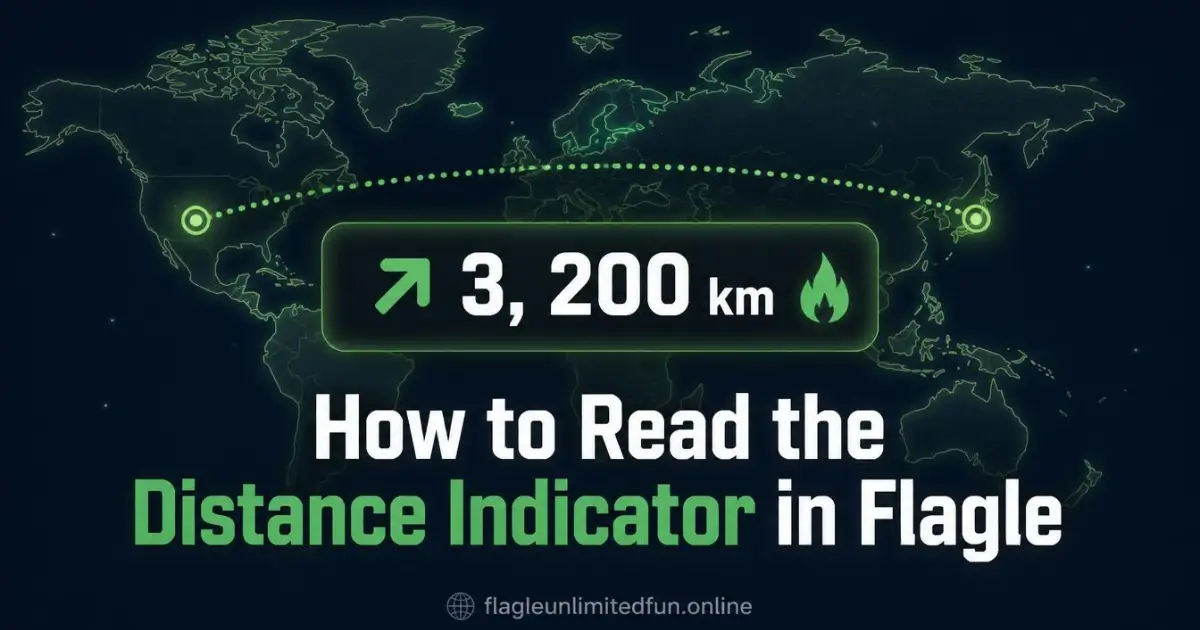
Many players look at the kilometer number and barely register the arrow. This is backwards. The arrow is often more useful than the distance. Knowing that the correct country is northeast of your guess gives you a specific direction to search. Knowing it is 3,000 km away without knowing which direction gives you a circle around your guess that could include dozens of countries.
Distance tells you the radius. Direction tells you where on that circle to look. Together they give you a specific arc on the map. After two guesses from different positions, you have two arcs that intersect at a small zone. By the third guess, a player who is reading both distance and direction accurately should know the continent and often the sub-region.
Players who only read the distance number are giving themselves half the available information per guess. The full method for reading both together is explained step by step in our complete distance indicator guide.
The Fix: After every guess, read the arrow first, then the distance. Ask: which direction from my guess country does this arrow point, and what is in that direction at this distance? That question answered correctly is worth more than three random guesses.
Mistake 3 — Starting With Small or Remote Countries
Starting with Luxembourg, Singapore, Iceland, or New Zealand as your first guess is a common mistake. These countries have interesting flags, and players sometimes guess them early because they are testing a specific hypothesis. The problem is that small and remote countries generate low-quality geographic data. A distance of 8,000 km from Singapore tells you very little about where in the world the answer is, because Singapore is itself in a corner of the globe.
Large, centrally positioned countries generate high-quality data because their geographic position means the distance and direction from them is interpretable across a wide range of answers. A distance of 3,000 km northwest of Nigeria immediately suggests North Africa or Southern Europe. A distance of 4,000 km from Singapore requires much more calculation to interpret, because Singapore's position makes the circle of possible answers less intuitive.
The five best opening guesses in Flagle are Russia, Brazil, Nigeria, Kazakhstan, and Turkey. Each one covers a different geographic crossroads and generates useful data for almost any correct answer. This is documented fully in our starting countries guide.
The Fix: Open every game with a large, centrally positioned country unless you are confident you already know the answer. Save small countries for later guesses when you are already narrowing down a specific region.
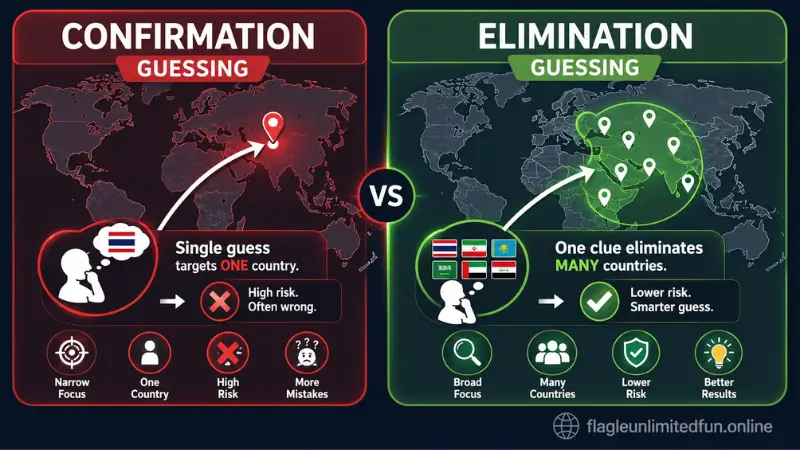
Mistake 4 — Guessing to Confirm Instead of to Eliminate
This is the most common mistake among intermediate players. You see a red flag with three horizontal stripes and you think it might be Russia. So you guess Russia to confirm your hypothesis. Russia is wrong, and the arrow points south. Now you have confirmed only that it is not Russia, which you could have established by guessing a country further south that would have told you which part of the southern hemisphere or which sub-region you were in.
Strong players make guesses designed to eliminate entire regions, not to confirm specific countries. If you think the flag might be from East Asia, do not guess China hoping to get lucky. Guess a country positioned to tell you whether the flag is in East Asia, Southeast Asia, or Central Asia. The answer will eliminate two of those three regions regardless of whether it is correct.
This shift from confirmation to elimination thinking is the single biggest improvement most players can make. It is the same cognitive shift discussed in our complete improvement guide, and it applies to every guess after the first.
The Fix: Before each guess, ask not "is this the right answer?" but "what will this guess tell me regardless of whether it is correct?" A guess that eliminates half the remaining candidates is always more valuable than a guess that confirms one specific hypothesis.
Mistake 5 — Getting Stuck on Visually Similar Flags
Chad and Romania are vertical blue-yellow-red tricolors. Indonesia and Monaco are horizontal red-over-white bicolors. Ireland and Côte d'Ivoire are vertical green-white-orange and orange-white-green tricolors. Many players recognize that they are looking at one of these pairs but cannot tell which one, and they either guess randomly or waste attempts trying to find a visual difference that does not exist at standard flag size.
The solution to visually identical flag pairs is always geographic. Chad is in Central Africa. Romania is in Eastern Europe. Indonesia is in Southeast Asia. Monaco is in Western Europe. If you know which pair you are looking at, one geographic probe guess resolves the pair completely. You do not need to see the visual difference. You need to know which hemisphere you are in, and one guess from a well-positioned country will tell you.
The most commonly confused flag pairs are covered in detail in our guides on why flags look similar and the hardest flags to identify. Both guides explain the geographic resolution method for each pair.
The Fix: When you recognize a flag as one of a similar pair, do not try to find a visual difference that may not be visible. Instead, make a geographic probe guess positioned between the two possible countries. The distance indicator will tell you which side of the world you are on.
Mistake 6 — Skipping the Daily Challenge
Players who only play unlimited mode improve more slowly than players who also do the Daily Challenge every day. The reason is repetition and comparison. The Daily Challenge gives you one flag per day that is the same for all players worldwide. This creates a natural reference point: you can compare your result against others, track your streak, and measure whether you are getting better over time.
More importantly, the Daily Challenge forces consistency. Unlimited mode lets you stop when you are tired or skip flags that are difficult. The Daily Challenge gives you no choice: one flag, one session, whatever result you get. That forced engagement with difficult flags is where the real learning happens. Players who build a daily challenge habit almost always see their unlimited mode scores improve as a side effect.
The Fix: Commit to the Daily Challenge every day, even on days when you are only going to spend a few minutes. One flag per day compounds into 365 flags per year of deliberate practice, covering nearly every type of flag you will encounter in unlimited mode.
Mistake 7 — Not Reviewing Losses
After a loss, most players immediately start a new game. The loss is uncomfortable and the instinct is to move past it. This is exactly backwards from how improvement works. Every loss contains specific information about what you do not know, and that information is available for about thirty seconds before you move on and it is gone.
After each game, spend thirty seconds asking: what specifically did this flag have that I should have recognized? What geographic reasoning would have gotten me there faster? If the answer is "I just did not know this flag," make a mental note of the country and look at where it sits on a map. If the answer is "I knew the region but guessed the wrong country," identify which detail would have separated them.
This deliberate review is the habit that converts game time into actual learning. Without it, you are just playing. With it, every game is also a lesson. The guide on how Flagle improves geography explains the mechanism behind this in more detail.
The Fix: After every game, win or lose, identify one specific thing you learned or could have done better. Write it down if you want to accelerate the process. The players who improve fastest are the ones who turn losses into lessons rather than skipping past them.
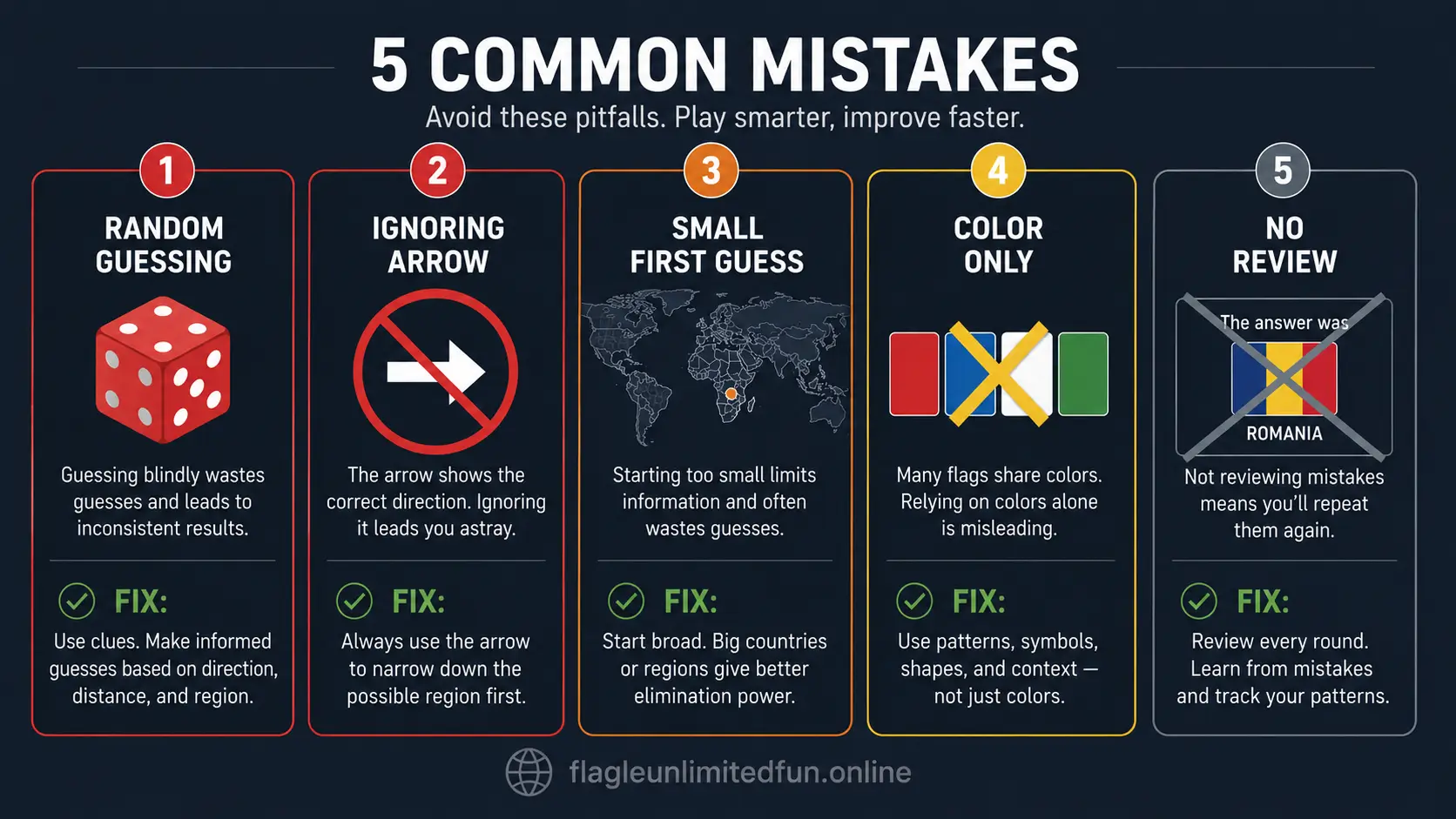
Mistake 8 — Relying Only on Color for Identification
Color is the first signal you get from a flag, and it is genuinely useful. But players who rely on color alone as their primary identification method hit a ceiling quickly, because there are dozens of flags that use the same colors. Green, yellow, and red appear on roughly twenty African flags. Red, white, and blue appear on more than thirty flags across Europe and the Americas. A player who sees "green, yellow, red" and thinks "Africa" has made a useful first approximation, but needs more information to get to the specific country.
Color should be the starting point of your analysis, not the end point. After identifying the dominant color scheme, the next question is: what else is on this flag? A star? An emblem? A pattern? The presence or absence of these secondary elements is usually what separates similar flags from each other. Our guide on what flag colors actually mean explains which colors are diagnostic of which regions, so you can use color as a geographic filter rather than just a visual observation.
The Fix: Use color to identify the likely region, then use secondary details like stars, emblems, patterns, and stripe arrangement to identify the specific country. Never stop analysis at color alone.
Mistake 9 — Having No Mental Map of the World
The distance indicator in Flagle gives you kilometers and a compass direction after every guess. This information is only useful if you have a rough mental map of where countries sit relative to each other. A player who does not know that Tajikistan is east of Uzbekistan, or that Benin is west of Nigeria, cannot use the direction arrow effectively for those flags.
Building a mental map does not require memorizing every country's coordinates. It requires knowing roughly which countries border which, where the major geographic clusters are, and which direction is "toward Europe" versus "toward South America" from different starting points. This knowledge builds naturally through playing Flagle regularly, but it builds faster if you actively consult a world map after unfamiliar results and note where the correct country sits relative to your guess.
The flag reference page lets you browse all flags, and using it alongside a world map after difficult games accelerates the mental map building process significantly. Our guide on how Flagle improves your geography explains why this knowledge builds naturally through play.
The Fix: After any game where you were surprised by the correct answer's location, find it on a world map and spend thirty seconds noting what borders it, what continent it is in, and what major country it is closest to. This builds the mental map faster than passive play alone.
Mistake 10 — Rushing the First Guess
The first guess is the most valuable guess in Flagle because it generates information that shapes every subsequent guess. Players who rush it, guessing whatever country comes to mind first, consistently perform worse than players who spend five to ten seconds thinking about which opening guess will give them the most useful data.
Before your first guess, look at whatever portion of the flag is visible in the first revealed tile. Does it give you a color hint? A pattern? A shape? If yes, use that to form a hypothesis about the region, and then choose a starting country positioned to test that hypothesis. If the first tile gives you nothing useful, fall back on one of the standard high-value openers like Russia or Brazil.
This five-second pause before the first guess is the cheapest improvement available to any player. It costs nothing but a few seconds and it turns the first guess from a coin flip into a strategic decision. Combined with the full approach described in our improvement guide, it is part of a system that consistently produces lower attempt averages over time.
The Fix: Pause for five seconds before your first guess. Look at whatever the first revealed tile shows. Form a hypothesis, or choose a standard high-value opener if the tile shows nothing useful. Never guess the first thing that comes to mind without that pause.
Putting It Together
These ten mistakes share a common root: treating Flagle as a memory test rather than a deduction game. The players who improve fastest are the ones who shift from "do I recognize this flag?" to "what can I deduce about where this flag is from?" That shift turns every guess into a source of information and turns every loss into a lesson.
Fix the mistakes in order of how often they cost you attempts. For most players, random guessing and ignoring the direction arrow are the two highest-impact fixes. Start there. Once those habits are solid, work down the list. Within a few weeks of deliberate practice on the Daily Challenge, you will see the improvement in your statistics on the leaderboard.