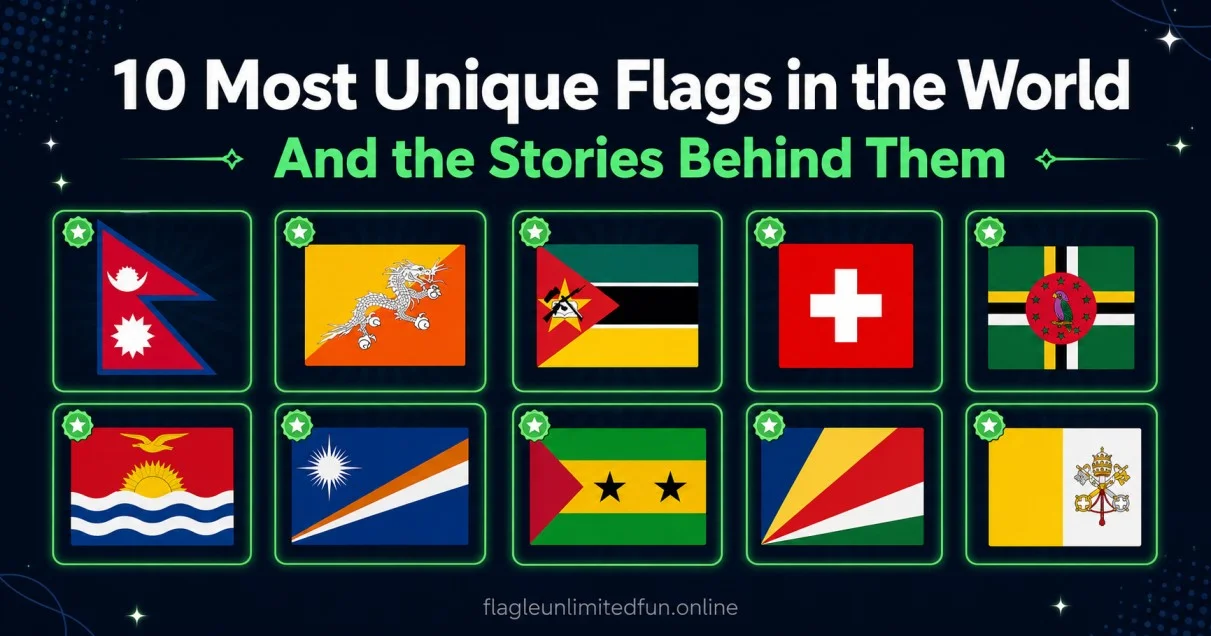
Most national flags follow a recognizable formula: horizontal or vertical stripes, a symbol in the center, two or three colors. The formula works because flags need to be recognizable at a distance, reproducible at scale, and meaningful at a glance. But some countries broke every rule and produced flags so unusual that they stand completely alone in the world of vexillology.
This list covers the ten most genuinely unique national flags in the world. Not the prettiest, not the most complex, but the ones that do something no other flag does. Each entry explains what makes it singular and why it looks the way it does.
What Makes a Flag Truly Unique?
Vexillologists use several criteria to measure flag uniqueness: non-standard shape, symbols found on no other national flag, unusual color combinations, and design elements that break the standard rules of flag design. The flags on this list score high on at least one of these criteria and in most cases break multiple conventions simultaneously.
Table of Contents
- 1. Nepal — The Only Non-Rectangular Flag
- 2. Bhutan — The Only Flag With a Dragon
- 3. Mozambique — The Only Flag With an AK-47
- 4. Dominica — The Only Flag With Purple and a Parrot
- 5. Switzerland — The Only Square Flag (Almost)
- 6. Kiribati — The Most Detailed Ocean Scene
- 7. Turkmenistan — The Most Complex Flag on Earth
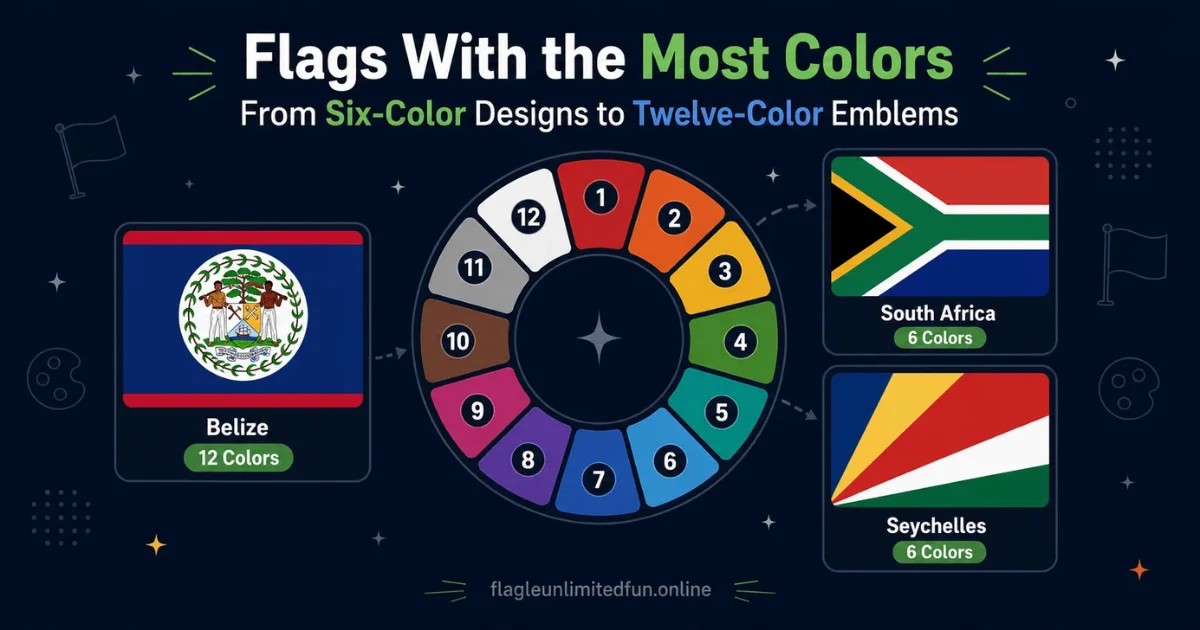
- 8. Belize — A Coat of Arms With Human Figures
- 9. Saudi Arabia — The Only Flag You Cannot Reverse
- 10. Zambia — The Only Flag With Its Emblem in the Corner
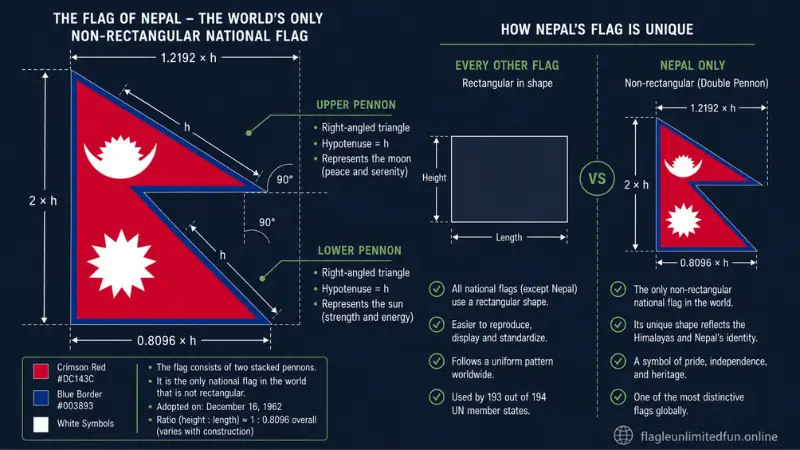
1. Nepal — The Only Non-Rectangular Flag
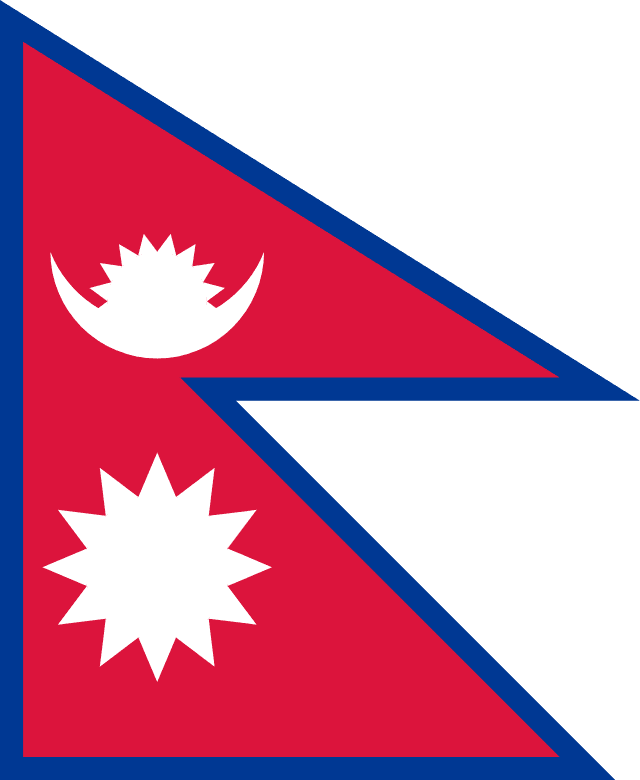 Nepal
NepalNepal's flag is the most structurally unique national flag in the world. Every other sovereign nation uses a rectangle. Nepal uses a double-pennon: two stacked triangular shapes that together form a shape unlike any other flag in existence. The design is enshrined in Nepal's constitution with precise mathematical specifications — the exact angles, proportions, and dimensions are written into law.
The double-pennon shape evolved from two separate pennants historically carried by different branches of the Nepalese ruling family. These were eventually combined into a single flag, keeping the distinctive shape. The crimson red represents the color of the rhododendron, Nepal's national flower, and the blue border represents peace. The white symbols — a moon in the upper pennon and a sun in the lower — represent the royal house and the prime ministerial family respectively.
Nepal's flag is the answer to one of the most common flag trivia questions in the world. It is also one of the hardest flags to draw correctly from memory, because the brain instinctively tries to make it rectangular. In Flagle Unlimited, Nepal is one of the easier flags to identify once you know it — the shape is unmistakable the moment it appears in the puzzle tiles.
Flagle Tip: If you see an unusual angular shape in the flag tiles that does not fit the standard rectangle, guess Nepal immediately. No other flag has this shape. It is the fastest automatic point available to any player who knows this fact.
2. Bhutan — The Only Flag With a Dragon
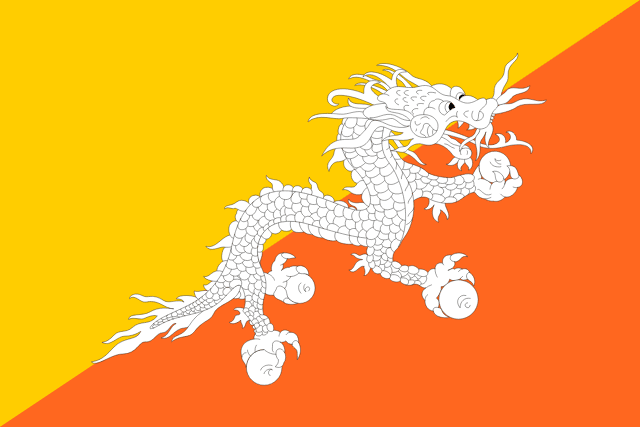 Bhutan
Bhutan's flag is diagonally divided into orange and yellow, with a white dragon called the Druk, or Thunder Dragon, running across the center. The dragon clutches jewels in its claws. No other national flag in the world features a dragon of any kind, making Bhutan's flag immediately identifiable the moment you know what to look for.
Bhutan calls itself Druk Yul, meaning the Land of the Thunder Dragon. The dragon on the flag is the same symbol that has represented the Bhutanese kingdom for centuries, appearing in royal seals, architecture, and religious art throughout the country. The orange half of the flag represents the Buddhist monastic tradition and the spiritual power of the Drukpa lineage. The yellow half represents the secular authority of the royal dynasty.
The dragon's white color represents purity. The jewels in its claws represent the wealth and security of the nation. The snarling expression is deliberate, representing the ferocity with which Bhutan's protector deities defend the kingdom. Every element of this flag carries specific symbolic weight that reflects Bhutan's self-image as a Buddhist kingdom protected by powerful spiritual forces.
3. Mozambique — The Only Flag With an AK-47
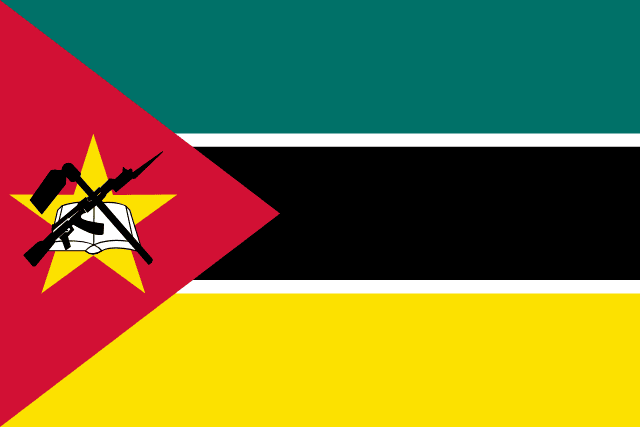 Mozambique
Mozambique's flag is the only national flag in the world to feature a modern automatic weapon. In the red triangle at the hoist, an AK-47 with a bayonet attached is crossed over a hoe and an open book. These three objects together represent the three pillars of Mozambique's post-independence ideology: defence, agriculture, and education.
Mozambique gained independence from Portugal in 1975 after a decade of armed struggle led by Frelimo, the Mozambique Liberation Front. The AK-47 was the primary weapon of Frelimo fighters, and its inclusion on the flag was a deliberate statement: this nation was built through armed resistance, and it will defend itself. The flag was adopted in 1983 and has survived multiple government discussions about redesigning it to remove the weapon. Each time, the decision has been to keep it.
In 2005, a national competition was held to redesign the flag. The winning design removed the AK-47. The government ultimately rejected the winning design and kept the original. The rifle stays because it represents something real and specific about Mozambique's history that a more conventional flag design cannot capture. For more on why this flag trips up players, read our hardest flags guide.
4. Dominica — The Only Flag With Purple and a Parrot
 Dominica
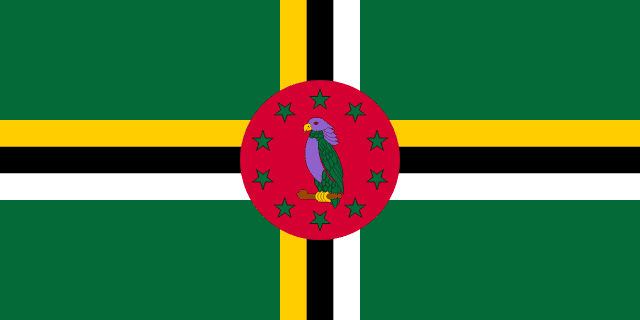
Dominica's flag is remarkable for two reasons. First, it contains more purple than any other national flag in the world, appearing in the plumage of the Sisserou parrot at the center of the flag. Second, that parrot, the Sisserou or Imperial Amazon, is found only on the island of Dominica, making it a symbol that exists nowhere else on Earth.
The flag's background is green, representing the lush tropical forests of the island. A triple-colored cross in yellow, black, and white runs across the flag, with the colors representing the Carib, African, and European peoples of the island. At the center sits a red circle containing the Sisserou parrot surrounded by ten green stars representing the ten parishes of Dominica.
Purple is extraordinarily rare on national flags because for most of history, purple dye was so expensive to produce that it was reserved for royalty. When synthetic dyes became available, most national flags had already been established with other colors. Dominica's use of purple is a product of the parrot's natural coloring rather than any symbolic intent, but the result is a flag unlike any other.
5. Switzerland — The Only Square Flag
 Switzerland
 Vatican City
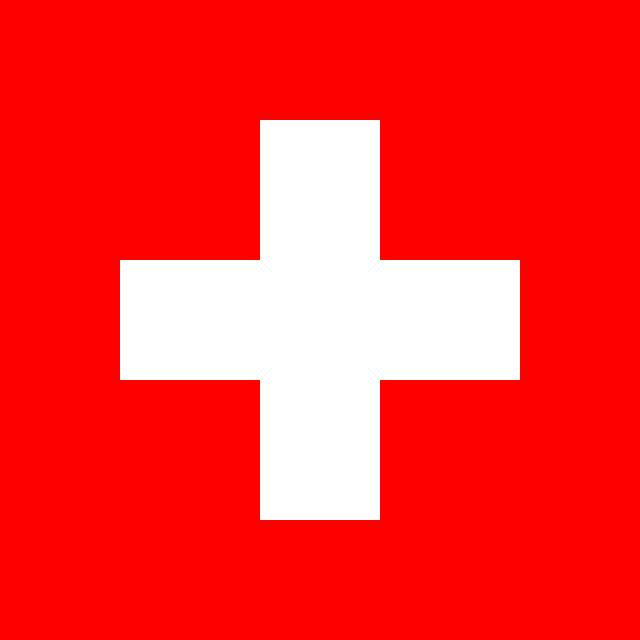
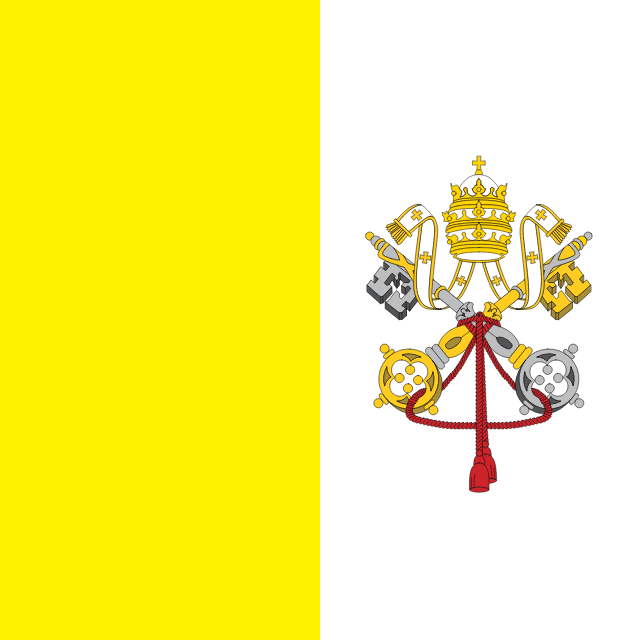
Switzerland's flag is one of only two square national flags in the world, the other being Vatican City. Every other sovereign nation uses a rectangular flag in landscape orientation. Switzerland's red field with a white cross is exactly square, with the cross centered and each arm of equal length.
The square shape dates to the Swiss military tradition of using square banners in battle. The white cross on red has been the symbol of the Swiss Confederation since the Battle of Laupen in 1339, where Swiss soldiers wore it to identify each other in combat. The cross represents Switzerland's Christian heritage. The red background represents the blood of Swiss soldiers.
Switzerland's flag is clean enough to be drawn from memory by almost anyone who has seen it once, making it an exception to the general rule that unique flags are harder to identify. Its distinctiveness comes entirely from the shape, a fact that only becomes apparent when the flag is flying next to rectangular flags and visibly does not match their proportions.
6. Kiribati — The Most Detailed Ocean Scene
 Kiribati
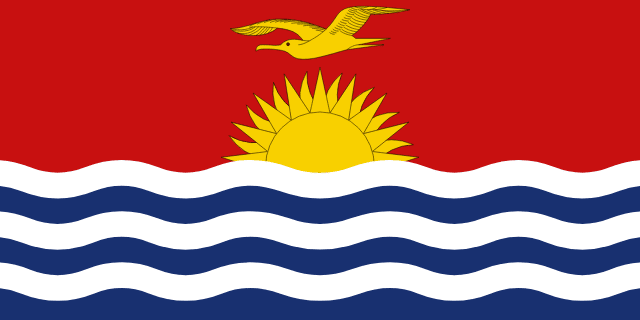
Kiribati's flag breaks almost every principle of conventional flag design by including a detailed pictorial scene: a golden rising sun above ocean waves, with a frigate bird in flight across the upper half. The lower half is blue with three horizontal white wavy lines representing the three island groups: the Gilbert, Line, and Phoenix Islands.
Most vexillologists would call this design overly complex for a flag. Detailed illustrations lose clarity at small sizes and are difficult to reproduce consistently. But Kiribati's flag is one of the few cases where the complexity serves the identity of the nation rather than cluttering it. Kiribati is a Pacific archipelago spread across a vast area of ocean. The sun, the bird, and the waves are not decorative elements; they are the literal environment in which the Kiribati people live.
The frigate bird is particularly significant. Known locally as a guide to lost fishermen, the frigate bird symbolizes strength, command over the sea, and freedom. The bird's distinctive shape in silhouette, with long wings and a forked tail, is recognizable even at small flag sizes, which is one of the reasons the design works better in practice than it might appear to on paper.
7. Turkmenistan — The Most Complex Flag on Earth
 Turkmenistan
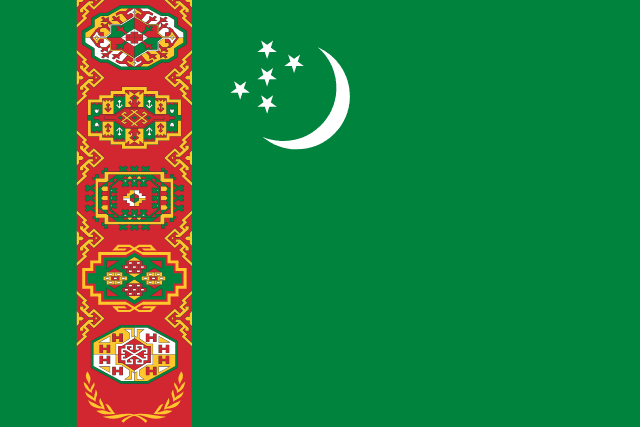
Turkmenistan's flag is widely considered the most intricate national flag in the world by vexillologists. On the left side runs a vertical stripe containing five traditional carpet guls, which are ornate geometric patterns specific to Turkmenistan's five major tribal groups. Each gul is a different design, and all five are rendered in full detail at flag scale.
The carpet is the central artistic tradition of Turkmen culture. The five guls on the flag are not decorative approximations but accurate representations of real tribal patterns that have been woven into Turkmen carpets for centuries. The rest of the flag is solid green with a white crescent moon and five white stars arranged vertically, representing the five regions of the country.
Turkmenistan gained independence from the Soviet Union in 1991 and adopted this flag in 1992, with the current version finalized in 2001. The explicit decision to use carpet guls rather than a simpler abstract design was a statement of cultural revival after decades of Soviet rule, which had suppressed traditional Turkmen identity. The complexity of the flag is intentional and represents the richness of a culture that was nearly erased. For a deeper look at this flag in a game context, see our guide to the hardest flags to identify.
8. Belize — A Coat of Arms With Human Figures
 Belize
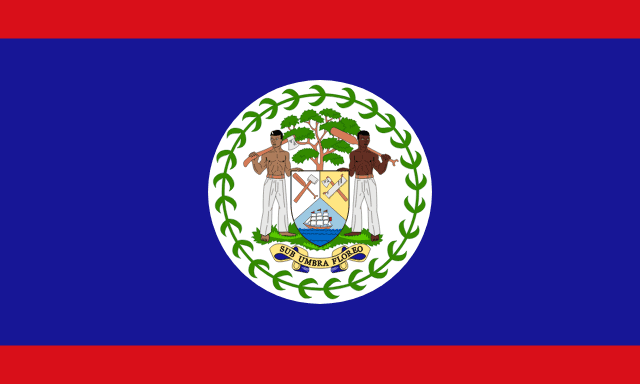
Belize's flag is notable for being the only national flag in the world whose coat of arms contains human figures. The coat of arms shows two men holding tools: a mestizo man with a paddle and a Creole man with an axe, standing on either side of a mahogany tree above a shield containing a ship and woodcutting tools.
The human figures represent the multiethnic workforce that built Belize's economy through the logging industry. The mahogany tree was the primary economic resource of British Honduras, as Belize was known during the colonial period. The motto below the coat of arms reads "Sub Umbra Floreo," meaning "Under the Shade I Flourish," a direct reference to the mahogany tree under which Belizean prosperity grew.
The flag uses an unusual color combination for Central America: blue and red as the primary field colors, with the coat of arms in a white circle at the center. The blue and red represent the two main political parties of Belize, the PUP and UDP, which agreed to combine their colors in the national flag as a symbol of unity at independence in 1981.
9. Saudi Arabia — The Only Flag You Cannot Reverse
 Saudi Arabia
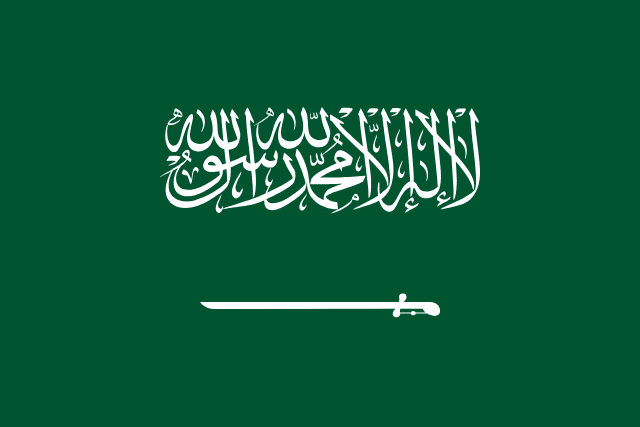
Saudi Arabia's flag is unique in several ways simultaneously. It is the only national flag whose primary design element is text: the Shahada, the Islamic declaration of faith, written in white Arabic script: "There is no god but Allah, and Muhammad is the Messenger of Allah." Below the text is a white sword with its tip pointing toward the hoist.
Because the Shahada is sacred text, it cannot be displayed upside down or reversed. This means Saudi Arabia's flag is the only national flag in the world that cannot be flown on both sides of a flagpole using a single piece of fabric. Saudi flags are always manufactured as double-sided pieces with the text oriented correctly on both faces, or as two separate flags placed back to back, a practical consequence of treating the flag as a religious object rather than purely a national symbol.
The green background represents Islam, making it one of the clearest examples of a flag where color and text together create a religious statement rather than a national one. Saudi Arabia does not fly its flag at half-mast out of respect for the dead because doing so would lower the Shahada, which is considered disrespectful to God. Even funerals of Saudi kings are conducted without the flag at half-mast.
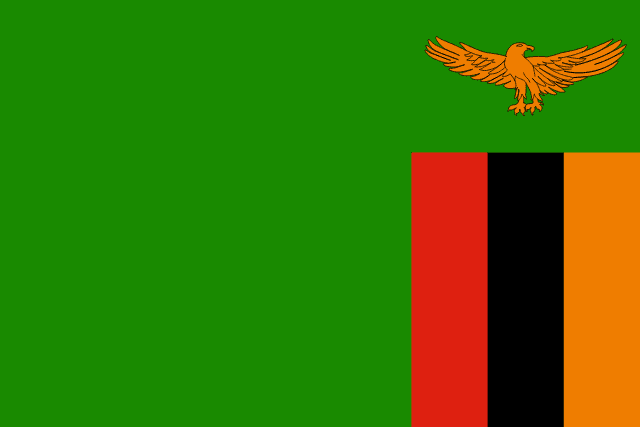
10. Zambia — The Only Flag With Its Emblem in the Corner
 Zambia
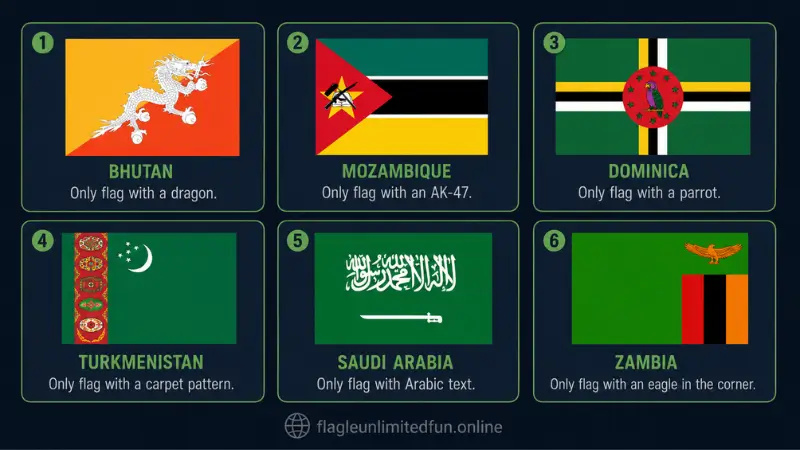
Zambia's flag breaks one of the most fundamental conventions of flag design: the emblem is placed in the lower right corner, the fly end, rather than at the center or the hoist. Almost every flag that uses a central emblem places it either in the center of the field or in the upper left canton near the flagpole. Zambia's African Fish Eagle sits in the lower right corner, separated from the three vertical stripes of red, black, and orange that run along the right side of an otherwise plain green field.
The placement is unusual enough that even experienced vexillologists describe Zambia's flag as one of the most visually unconventional designs among African flags. The green represents Zambia's natural vegetation and agricultural land. The red represents the struggle for freedom, the black represents the Zambian people, and the orange represents the country's mineral wealth, specifically copper, which has been the backbone of Zambia's economy since independence.
The African Fish Eagle at the top right represents freedom and the ability of the nation to rise above its challenges. The specific placement in the corner was a deliberate design choice to give the flag an asymmetric, dynamic quality that stands out from the many symmetrical flag designs used by neighboring countries.
What These Flags Have in Common
Looking at these ten flags together, a pattern emerges. The flags that are most unique are almost always the ones where the design choices were driven by something specific and irreplaceable: a shape with centuries of tradition behind it, a cultural symbol found nowhere else in the world, a historical event that demanded commemoration in the most direct way possible.
Generic flag design produces generic flags. The flags that stand apart are the ones that prioritized telling a specific story over following the conventions of what a flag is supposed to look like. Nepal's double-pennon exists because two royal families needed to be represented. Mozambique's AK-47 exists because a war was fought and won. Dominica's parrot exists because the bird lives nowhere else.
These stories are what make flag recognition rewarding rather than merely mechanical. Understanding why a flag looks the way it does turns a visual memory task into something richer. And in Flagle Unlimited, that understanding translates directly into faster identification and fewer wasted guesses. Study the story, and the flag follows. Try the Daily Challenge every day and see how quickly the unusual flags start to feel like the most recognizable ones you know.